两个 intervention arms
Y(0)↔Y(1)
主问题是两个已声明 arms 之间的 conditional contrast。
HCGM-Dose 从 pretreatment covariates abduce latent unit,再把任意 dose \(a\) 送入共享、可微的 structural mechanism。它提供解析的预测分布、 quantile surface、finite-dose contrast 与 local derivative——同时明确告诉你: 哪些由数据识别,哪些只是平滑外推。
变化不只是 \(T\in\{0,1\}\) 变成 \(A\in\mathbb R\)。连续 treatment 额外引入局部 support、函数平滑性、dose derivative,以及跨 dose counterfactual coupling。
主问题是两个已声明 arms 之间的 conditional contrast。
每个 dose 都是一个 intervention query;邻域 support 决定 derivative 是否有因果含义。
平滑曲线可以延伸到数据没去过的地方,但那是 model extrapolation,不是 causal identification。
下面每一步都改变了讨论对象。任何一步缺失,都不能用下一步的公式替代。
上标 \(i\) 只给 observations 编号;\(u^{(i)}\) 是该 record 对应的 token realization,不定义 \(U_i\) 或独立的 unit functions。每个 token 只出现一个 factual dose 和 outcome;完整 dose path 不可同时观测。
这是 causal target 的定义,还不是从 observed data 得出的结论。
weak exchangeability 是逐 dose 的条件,不声称整条过程 \(\{Y(a):a\in\mathcal A\}\) 与 assignment 联合独立。
右侧应理解为 regular conditional distribution;continuous \(A\) 下不是对零概率事件 \(A=a\) 做朴素频数条件化。Derivative 还要求邻域 support 与可微性。
只有在正确 Cauchy specification、有限 cross-entropy 与 population global optimum 下,factual log-risk 才 Fisher-consistently 恢复 supported dose-indexed predictive distribution。
Identification 说明 causal marginal 等于哪个 observed conditional law;Fisher consistency 说明 chosen likelihood 在什么模型条件下恢复该 conditional law。后者不能替代前者的 causal assumptions。
Cauchy affine closure 把 latent uncertainty 精确传播成每个 dose 下的 response distribution,无需 Monte Carlo latent sampling。
世界里已有 \(U=u^\star\)。\(X=x\) 是 factual evidence,分布是 learner 对同一个实际 token 的 epistemic result;dose 不进入 abduction,也不会为 alternative dose 重抽 identity。一般可选 point、Gaussian 或 Cauchy;本文实证后两者。Cauchy 的 \(\mu,\gamma\) 是 location/scale,非退化时没有 finite mean/variance;重尾不等于任意 outcome 都可生成。
\(c_\theta,w_\theta,\sigma_\theta\) 随 dose 连续变化;固定同一 factual abduction result,只改变 \(a\) 查询 \(Y_u(a)=f_\theta(a,E;u)\)。
location 与 scale 分别是 \(m_\vartheta=c_\theta+w_\theta^\top\mu_\phi\) 和 \(s_\vartheta=\sum_j|w_{\theta,j}|\gamma_{\phi,j}+\sigma_\theta\)。
对每个 factual observation \((x_i,a_i,y_i)\),最小化 Cauchy negative log-likelihood:
这一步解释模型怎样估计 observed conditional law;它本身不会创造 exchangeability,也不会为 unsupported dose 提供 identification。
每个 dose 下的 conditional median / location。
latent uncertainty 与 event noise 的解析传播。
同一 dose-indexed 预测分布上的任意 conditional quantile。
只在邻近 doses 都有 support 时解释为 local causal estimand。
两个已支持 doses 的 location difference;它不等于已识别的 individual-level random contrast law。
核心假设是 consistency、no interference、pointwise weak exchangeability 与 conditional dose-density positivity。HCGM-style abduction 不会修复 hidden confounding。
| 对象 | 状态 | 边界 |
|---|---|---|
| \(F_a,Q_a,m(a,x)\) on support | identified | 需要 consistency + exchangeability + positivity |
| \(g(a,x)\) | locally identified | 还需要邻域 support 与 differentiability |
| fitted \(m_\vartheta,s_\vartheta\) | risk-recovered | 正确 Cauchy specification + population optimum |
| unsupported dose surface | model extrapolation | smoothness 不能补回缺失的数据支持 |
| \(Y(a)-Y(a')\) 的完整随机分布 | coupling-dependent | 必须额外指定 cross-dose event-noise coupling |
| latent coordinates \(U_j\) | model-implied | 预测分布可恢复不代表 latent gauge 唯一 |
若 \((x,a)\notin\mathcal S_\varepsilon\),模型仍可数值求出 \(m_\vartheta(a,x)\),但网页和论文都应把它标为 extrapolation;若要解释 \(g(a,x)\),还需 \(a\) 的邻域落在 support 内。
两种 coupling 都保持每个 dose 下的 response marginal,却给出不同的 contrast scale 与 probability of benefit。
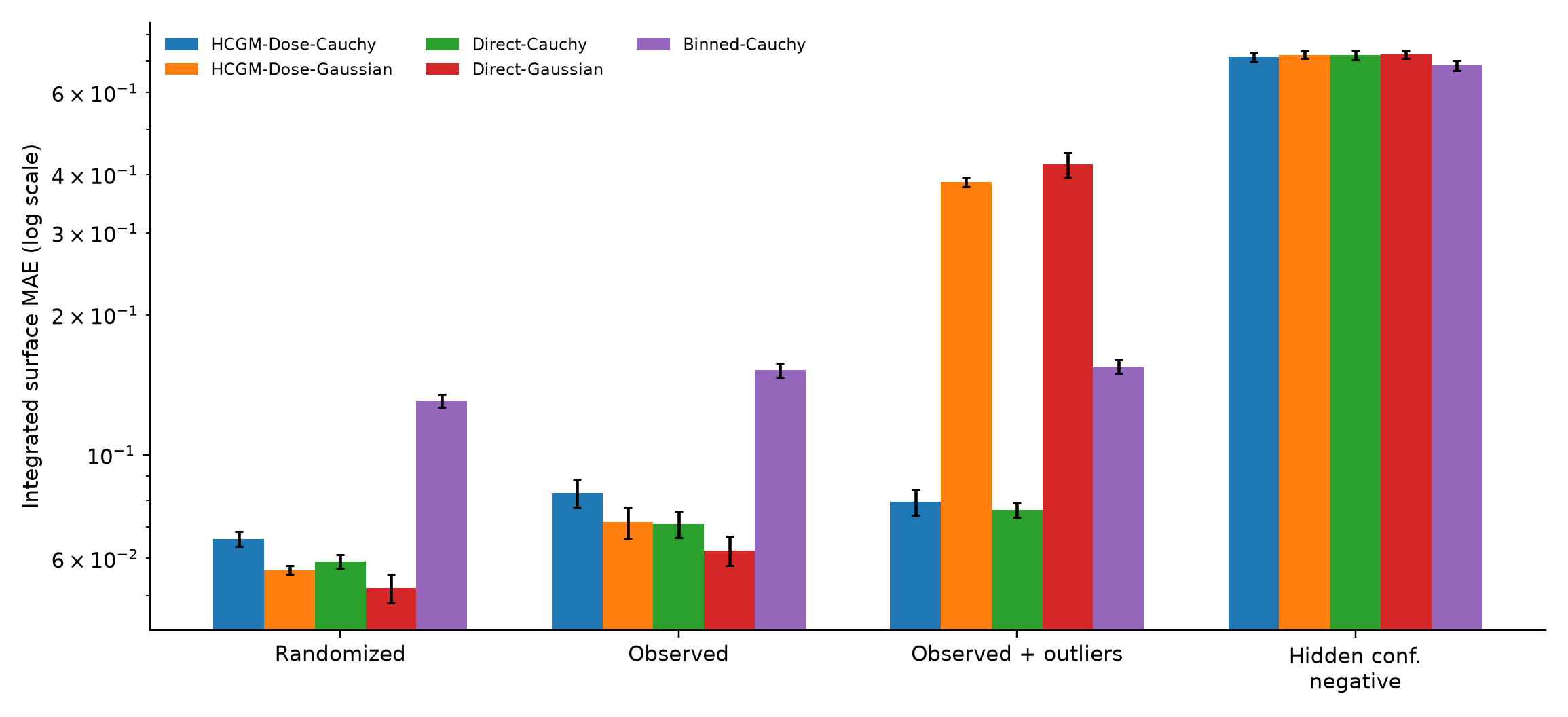
所有数字来自 frozen CSV;本页 build 会检查完整 grid、有限值与 replication counts。Lower is better。
干净 Gaussian outcomes 上,matched Gaussian learners 更有优势。
5% gross-label contamination 下,Cauchy learners 保持稳定,Gaussian variants 明显退化。
hidden confounding negative control 中,abduction 与 factual likelihood 都无法恢复 exchangeability。
前 3 个场景比较 recovery 与 robustness;最后一组是 identification failure diagnostic,不是可识别 regime。
五个独立生成 datasets;VCNet-TR 的平均 ADRF MSE 最低。
这里的 strong support 使用 exact treatment density 阈值 \(f_{A\mid X}(a\mid x)\ge 0.10\)。拖动 selection strength,查看同一 HCGM-Dose-Cauchy 的三类误差。
在 selection strength 0.5,绝大多数 query cell 有 strong support。
把 HCGM 的 abduction → intervention → reduction 推广成可微的 continuous mechanism path,并保持解析 response distribution。
在有 support 和 exchangeability 的区域学习 dose-indexed marginal predictive distributions,而不是声称恢复完整 counterfactual process。
不宣称 universal benchmark superiority,不把 smooth extrapolation、hidden-confounding recovery 或 cross-dose joint law 冒充识别结果。
网页数字由 frozen outputs 构建。完整 proofs、protocol details、per-seed rows 与 runtime provenance 保留在 paper package 中。
cd implementation
uv sync --extra dev
uv run pytest

uv run python experiments/render_artifacts.py
cd ..
./build.sh
python3 site/build.py
complete grids · finite values · source-derived web evidence